
Why this is the key to successful construction in live environments. This can make or break a project
Construction is usually measured against familiar benchmarks: programme, cost, quality and safety. But when the work happens inside a building that's still occupied and running, there's another measure that matters just as much - can the organisation carry on operating safely and effectively while it's happening around them?
A hospital doesn't stop treating patients because there's scaffolding up. A school doesn't stop teaching because a wing's being rebuilt. A stadium still has fixtures, supporters and sponsors to look after on a match day, whatever's going on behind the hoarding. The world outside the site boundary doesn't pause for construction and that changes how a project needs to be run.
At Helix CMS, we've delivered construction and refurbishment across live healthcare, education and other operational settings. Every one of those settings brings different risks and priorities, but the principle underneath successful delivery stays remarkably consistent: in a live environment, the construction programme is only one of two programmes running at once. The organisation occupying the building is running the other and getting the project right means making the two work together, not just fitting one around the other.

Staying operational becomes part of the construction methodology
Working in an occupied building requires a different approach to conventional construction: the building’s day-to-day operation becomes part of the construction methodology itself.
Before asking how are we going to build this?, there's a question that has to be answered first: what happens here every day and what absolutely cannot stop?
In a hospital, that might mean protecting patient and clinical pathways, access to departments, critical building services, infection prevention or emergency routes. In a school, it's different again - teaching has to continue, pupils and staff need to move safely around the site, safeguarding has to stay effective and construction has to work around the timetable rather than the other way round.
At a major sporting venue, the picture changes once more: fixtures, staff, supporters, hospitality, media, commercial partners and event-day requirements all decide when and how work can actually happen.
Leisure and hospitality add another variation. At Connexin Live in Hull, the schedule is back to back with live events and shows, so refurbishing main arena areas needs careful consideration. Helix turned an existing office room into a VIP Xperience Lounge for Connexin on a fast-track programme, with a starlight fibre optic ceiling and a bespoke bar. A space like that is judged on atmosphere but it only works if the unglamorous parts are right: new electrics tied into the building’s existing system and firestopping throughout to meet compliance standards.
Plan around the operation, not just the construction
A normal construction programme considers sequencing, labour, procurement, subcontractors and the dependencies between packages. A live-environment programme has to go further - working out how the building's actually used at different times, who needs access when, which services can never go down, when disruptive work can happen and what temporary arrangements will be needed to make it possible. That shapes everything from delivery times and welfare locations to temporary routes, service isolations, noisy works, dust control, hoarding and phasing.
South Hunsley School shows this in practice. It's a live 48-acre secondary and sixth-form campus serving more than 3,000 students, and early engagement with school stakeholders was essential just to understand daily schedules, logistics and pupil movement before a sequence could be agreed.
Works were phased around the school's own operation, with clearly segregated construction areas, controlled access and regular communication between the Helix team and school stakeholders throughout.
We've also delivered the £2.5m Ferriby Building at South Hunsley - a two-storey, 743sqm teaching facility built and fitted out while the rest of the school stayed fully operational around it. That meant clear segregation, safeguarding protocols, Enhanced DBS checks, bespoke inductions and close, ongoing collaboration with school staff.
Michaela Blackledge, Head teacher of South Hunsley School and Sixth Form, said: “This marks the realisation of a vision and I am immensely proud of a facility that will stand for generations as a beacon of what communities can create through strong partnerships.”
The same discipline has shaped our healthcare work too. At Hull Royal Infirmary, Helix delivered a four-phase refurbishment and extension of the Neonatal Intensive Care Unit - with the ward remaining live throughout every phase. That meant sequencing works around continuous clinical operation, protecting infection control and clinical pathways at every stage, and coordinating closely with hospital staff so that a unit caring for babies on life support - the most vulnerable patients in the building - was never compromised by the construction happening around it.
The lesson goes well beyond either sector. The most efficient sequence on paper isn't always the most effective one in a live environment. Something that could technically run as one continuous operation might need splitting into phases. A delivery that would normally turn up mid-morning might need to come at 6am instead. Access might need to shift temporarily. The most disruptive work might only be possible in a handful of tightly agreed windows.
That’s operationally intelligent planning: a programme built around the reality of the client’s operation, where effective delivery matters more than simply finding the shortest theoretical route to completion.
Control what happens inside the site and understand what happens outside it
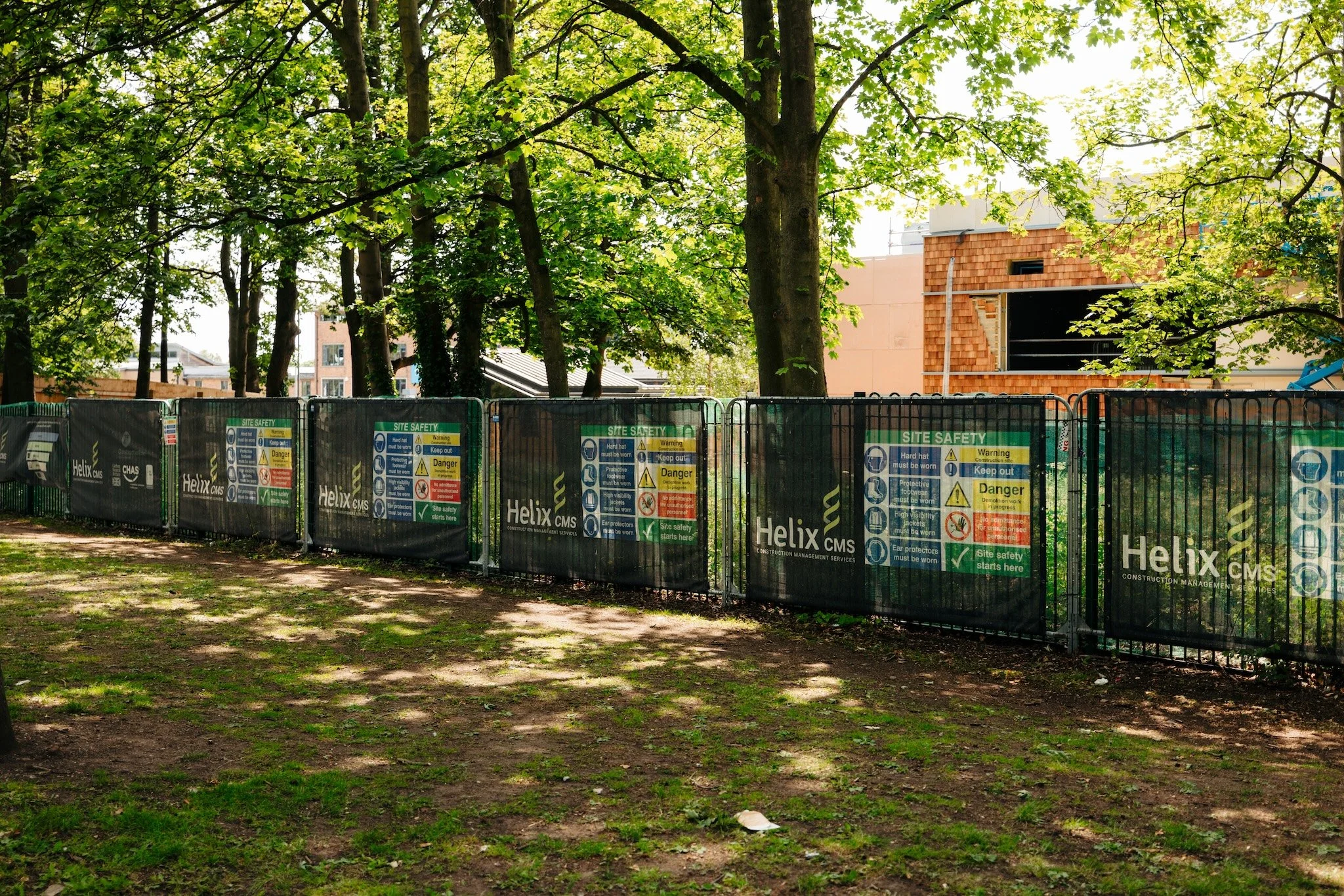
Physical segregation is fundamental wherever construction and everyday life share the same building or site. Hoarding, controlled access points, temporary routes, signage and secure storage all establish a clear boundary between the work and the people around it.
But a hoarding line on its own doesn't make a live site successful. Because buildings don't experience disruption, people do.
A patient doesn't know why their normal route through the hospital has suddenly changed. A pupil reacts to noise, unfamiliar faces or a broken routine differently to how an adult would. An employee still needs to get to a desk next to the construction area every day. A visitor walking through the door for the first time has no idea a construction programme even exists. Communication isn't a stakeholder exercise sitting alongside the real site management, it’s site management.
At South Hunsley, regular communication between the Helix team and school stakeholders was used to flag concerns early, manage risk and explain changes before they land as a surprise, backed up by school-specific signage and inductions.
But the approach went further than keeping pupils separate from the construction works. Helix ran live-site visits for more than 360 Year 9 pupils, supported work experience placements and worked directly with the school community - turning what could have been a disruptive unknown into something pupils could actually understand and engage with.
That's the real principle behind good live-environment construction management. It isn't only about controlling the site, it's about understanding everyone around it.
The right people, systems and information
Live environments also need strong systems behind the people actually doing the work. Our approach combines experienced site management with the digital tools that give the team visibility and control throughout delivery.
We use Procore as our project management platform, giving teams a full view of coordination, information, progress, quality and actions across the wider delivery team, and Breadcrumb at site level to manage safety controls and keep safety information consistent day to day.
None of that replaces experienced construction management or standing in front of someone and talking it through - it backs it up. When a live environment can change quickly, the team needs current information and a clear line of sight across the whole project: issues visible, responsibilities clear, decisions communicated without delay.
The people matter just as much as the systems. All Helix site staff hold Enhanced DBS clearance, which matters wherever our teams are working in occupied, sensitive environments and matters most where children or vulnerable people may be present.
At South Hunsley, that showed up as DBS-cleared personnel, bespoke inductions, safeguarding protocols, secure segregation, regular safety briefings and constant stakeholder communication, all running together rather than as separate boxes to tick.
No single measure makes a live environment safe. It’s the combination - people, planning, systems, physical controls and communication together - that does.
Different environments. The same fundamental challenge
Every live environment demands an approach shaped around how it actually operates. A hospital isn’t a school, an office isn’t a football stadium - the risks, stakeholders and pressures inside each one are genuinely different. That means understanding the specific environment rather than dropping in a standard construction methodology and hoping it fits.
In healthcare, clinical activity and patient safety come first - construction has to work around clinical pathways, infection prevention, critical services and departments that can't go offline. In education, safeguarding, teaching and pupil routine shape how a project gets sequenced, as South Hunsley shows: construction running across a campus serving thousands of pupils while keeping segregation tight and working closely with school leadership throughout.
At a major arena like Connexin Live, the shape of the challenge changes again - the building has its own operational demands and for a hospitality space, the guest experience is part of the brief.
The controls change from one environment to the next. The principle doesn't: understand what the client needs to keep doing and build the construction solution around that.
Expect change and plan for it
Even the best live-environment programme can't anticipate everything. Priorities shift, access requirements move, unexpected building conditions turn up, an urgent need elsewhere in the building changes what's possible this week or a stakeholder needs something nobody planned for.
The answer isn't to tear up the programme every time something changes - it's to build a delivery structure that can actually respond: clear communication routes agreed early, clarity on who can make which decisions, ongoing visibility of programme and risk, and genuine contingency built into the methodology rather than added as an afterthought.
That only works with a genuinely collaborative relationship between contractor and client. When both sides understand the pressures the other is under, decisions can be made in the interests of the whole project and organisation - not construction working to its own agenda in isolation.
Keeping the building working is part of building it
Live-environment construction takes real technical capability but technical capability on its own isn't enough. It takes contractors willing to listen before they build. To understand how the organisation actually operates, work out what genuinely cannot be disrupted and plan and phase accordingly. To put the right physical and digital controls in place, communicate clearly with people who've never worked alongside a construction site in their life and to adapt when the operational picture changes without warning.
At Cottingham Parks Golf & Leisure Club, Helix delivered three new extensions and a full refurbishment of the existing facilities across seven phases, with the club operating throughout. Internal hoarding, clear signage and designated pedestrian walkways kept staff, members and visitors safe, and the steel frame for the new entrance and orangery was reconfigured to sit independently of the existing structure, avoiding costly foundation work and helping maintain continuous club operation.
When it works, it’s the client who notices first. Rob Wiles, the client at Cottingham Parks, said: “I’m amazed at how you’re able to get all this work done without disrupting anything. It’s as if you’re invisible. I can’t believe you’ve managed such an ambitious transformation with no disruption to daily business.”
For Helix, this approach has come from hands-on delivery across occupied, operational environments right across the region. We don't expect hospitals, schools, businesses or venues to simply work around our construction programme. Our job is to understand what actually matters to the client and build a construction methodology that lets their operation and our programme run alongside each other rather than in competition.
Because in a live environment, keeping the building working is part of building it. Buildings don't experience disruption, people do. And that's who we're building around.
If you're planning a project inside a building that can't stop running while the work happens, we'd welcome an early conversation about how to make the two work together.